Introduction
The College of Nursing, FJMU / Sir Ganga Ram Hospital, Lahore is one of the most prominent public-sector nursing institutions in Pakistan. Operating under Fatima Jinnah Medical University and located within Sir Ganga Ram Hospital, the college plays a crucial role in producing qualified nursing professionals for the country’s healthcare system. With a legacy that dates back to the early years of Pakistan, the institution has evolved into a modern center of nursing education, combining academic excellence with extensive clinical training.
Historical Development
The origins of the College of Nursing can be traced to December 1948, when it was established as a nursing school shortly after the independence of Pakistan. It holds the distinction of being among the first nursing schools founded in the newly created state.
At the time of its establishment, Sir Ganga Ram Hospital had only a few wards and limited facilities. However, as the hospital expanded over the decades, the nursing school also grew in size, scope, and academic capability.
A major milestone in its history occurred on 26 October 2016, when the institution was formally upgraded from a nursing school to a full-fledged college. This transformation enabled it to introduce degree programs aligned with modern healthcare standards and international educational frameworks.
The development of the college is closely tied to the growth of Sir Ganga Ram Hospital, which was originally established in 1921 by philanthropist Sir Ganga Ram and later became a major tertiary care teaching hospital.
Institutional Affiliation and Role
The College of Nursing operates under the administrative and academic umbrella of Fatima Jinnah Medical University, one of Pakistan’s leading medical universities. The university itself was established in 1948 and later upgraded to university status in 2015, further strengthening its academic and research capacity.
As a constituent institution of FJMU, the College of Nursing benefits from a multidisciplinary academic environment. It collaborates with other departments and affiliated hospitals, ensuring that students receive both theoretical knowledge and practical exposure.
The integration with Sir Ganga Ram Hospital allows nursing students to gain real-world clinical experience in a large, busy, and diverse healthcare setting.
Academic Programs Offered
The college offers a range of undergraduate and postgraduate programs designed to meet national healthcare needs and global nursing standards.
1. Bachelor of Science in Nursing (BSN)
The BS Nursing program is a four-year degree aimed at preparing students for professional nursing practice. It includes:
- Core medical and nursing sciences
- Clinical rotations in hospital departments
- Research and community health training
2. Post-RN BS Nursing
This is a two-year program designed for registered nurses who wish to upgrade their qualifications. It emphasizes advanced clinical skills, leadership, and evidence-based practice.
3. Midwifery and Specialized Programs
The college has also initiated programs such as BS Midwifery in collaboration with international organizations like the United Nations Population Fund (UNFPA).
4. Lady Health Visitor (LHV) Program
The institution also offers training for Lady Health Visitors, focusing on maternal and community healthcare services.
Additionally, there are ongoing efforts to introduce postgraduate programs such as MS Nursing, which will further enhance academic and research opportunities.
Clinical Training and Practical Exposure
One of the defining features of the College of Nursing is its strong emphasis on clinical training. Students are trained within Sir Ganga Ram Hospital, a tertiary care facility that offers a wide range of medical services.
The hospital provides exposure to multiple specialties, including:
- Medicine and Surgery
- Obstetrics and Gynecology
- Pediatrics
- Emergency and Critical Care
- Specialized departments such as cardiology, neurology, and oncology
This hands-on training ensures that students develop practical skills, clinical judgment, and professional competence.
Facilities and Infrastructure
The College of Nursing provides a well-structured learning environment equipped with modern facilities. These include:
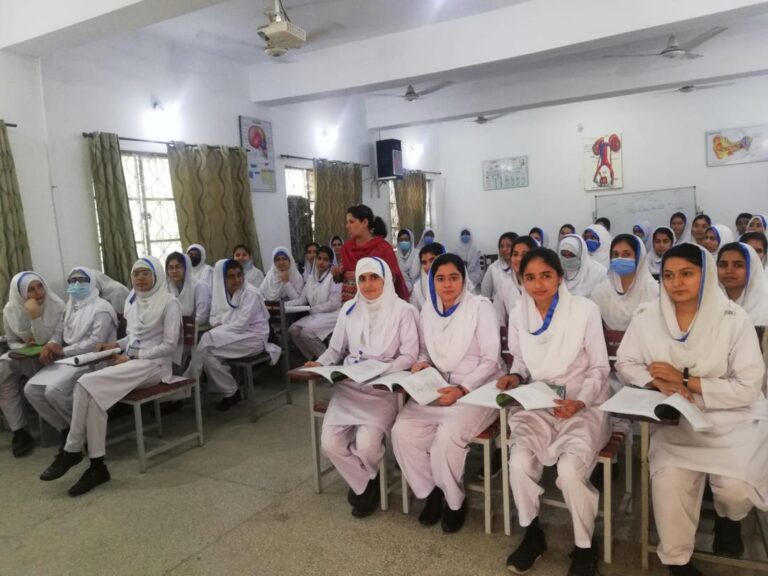
- Five lecture halls for academic instruction
- Demonstration rooms for practical learning
- A well-stocked library
- Skills laboratories for simulation-based training
- Hostel accommodation within hospital premises
These facilities support both theoretical learning and clinical skill development, enabling students to meet professional standards.
Admission Criteria and Merit System
Admissions to the College of Nursing are strictly merit-based and are regulated through standardized procedures, often managed by the University of Health Sciences (UHS).
For BS Nursing, the typical requirements include:
- F.Sc. (Pre-Medical) with at least 50% marks
- Punjab domicile
- Entrance test and merit evaluation
For Post-RN programs, candidates must already hold a nursing diploma and meet additional professional criteria such as work experience and registration with the Pakistan Nursing Council.
The transparent merit system ensures fairness and selection of competent candidates.
Contribution to Healthcare
The College of Nursing, FJMU / Sir Ganga Ram Hospital, Lahore plays a vital role in strengthening Pakistan’s healthcare system. Its contributions include:
- Producing highly trained and skilled nurses
- Supporting maternal and child health programs
- Enhancing community healthcare services
- Promoting research and evidence-based nursing practice
Graduates from the college serve in hospitals, clinics, and community health organizations across Pakistan and abroad.
Importance in Pakistan’s Nursing Education
Nursing education is a critical component of any healthcare system, and institutions like the College of Nursing at FJMU are essential for addressing the shortage of trained healthcare professionals.
By maintaining high academic standards and integrating clinical practice, the college helps improve the quality of patient care. Its affiliation with a major teaching hospital ensures that students are trained in real-life medical environments, which enhances their readiness for professional roles.
Challenges and Future Prospects
Like many public-sector institutions, the college faces challenges such as:
- Increasing demand for healthcare professionals
- Need for advanced research facilities
- Expansion of academic programs
However, ongoing developments, including the introduction of postgraduate programs and collaborations with international organizations, indicate a positive future.
The institution aims to achieve international standards in nursing education and contribute more effectively to global healthcare systems.
Conclusion
The College of Nursing, FJMU / Sir Ganga Ram Hospital, Lahore stands as a historic and academically significant institution in Pakistan. From its beginnings as a small nursing school in 1948 to its current status as a modern college, it has consistently contributed to the development of the nursing profession.
With its strong academic framework, excellent clinical training, and commitment to quality education, the college continues to produce competent, compassionate, and professional nurses. Its role in improving healthcare services and addressing national health challenges makes it an indispensable part of Pakistan’s medical education system.